Who Is Responsible for a Blocked Drain or Sewer?
When dirty water is backing up into your garden or your downstairs toilet refuses to flush, the first thing you need to know is whether you have to pay to clear it yourself or if United Utilities will come out and sort it for free. Here is the plain-English answer from an engineer who checks these boundaries every day.
The 30-Second Rule of Thumb
- 1. Your Responsibility: The blocked pipe only carries wastewater from your house and sits inside your property boundary.
- 2. Water Company (United Utilities): The pipe sits outside your boundary wall/fence, OR it is a shared pipe taking waste from both your home and a neighbour's—even if that manhole is in your back garden.
- 3. Local Council: Blocked roadside kerbs and street rainwater grids on public roads.
Private Drains vs Public Sewers: How the 2011 Rules Changed Everything
Before October 2011, homeowners were often stung with big repair bills for shared drains running across their gardens or down shared rear alleyways. Under the 2011 Private Sewer Transfer regulations, the government handed ownership of most shared pipes and lateral drains over to the regional water authorities—which across Merseyside and West Lancashire means United Utilities.
In simple terms, ownership doesn't depend on where your garden fence sits anymore; it depends on whose waste flows through the pipe. We break drainage pipework down into three distinct parts:
1. Private Drain
Any internal waste pipe, toilet branch, soil stack, outside kitchen gully, or underground run within your boundary that serves only your property up to the point it meets a neighbour's pipe or crosses the street boundary.
2. Lateral Drain
The section of single-property pipework that passes outside your property boundary (usually beneath the public pavement or grass verge) before dropping into the main sewer in the road.
3. Public / Shared Sewer
Any underground pipe that carries foul or surface water from two or more properties. The moment your neighbour's drain joins yours, that pipe becomes a public sewer—even if it runs directly under your patio.
Why Wait Times Matter in an Emergency
If a blockage is on a shared sewer, United Utilities will clear it free of charge, though during heavy rainfall or busy periods it can take 24 to 72 hours for a utility crew to attend unless raw sewage is actively flooding inside your living space. If you have one toilet in the house, children at home, or an overflowing patio gully and cannot wait days in a queue, many homeowners call us out on our 24/7 emergency drain unblocking service to get the line jetted clear straight away.
How to Check Before You Call Out an Engineer
Before you spend money on a private call-out, you can normally work out where the blockage sits in five minutes without getting your hands dirty. Here is the exact diagnostic checklist we walk customers through over the phone:
Check if only one appliance is blocked
If your upstairs toilet is rising to the rim when flushed, run the bathroom basin tap and check the kitchen sink. If the sinks drain away fast and outside gullies look completely normal, the obstruction is trapped locally in the toilet pan bend or internal branch pipe. That is 100% your private responsibility.
Ask your immediate neighbours
Knock next door and ask if their toilets are gurgling, draining slowly, or backing up into their outside grids. In older terraced streets across Wavertree, Anfield, and Toxteth, rows of houses feed into a single shared brick or clay sewer running down the back entry. If next door—particularly the neighbour further down the slope of the street—is also backed up, the shared sewer is blocked and United Utilities is responsible.
Inspect your outside gullies and manhole covers
Look at the Hoppers and grids outside your kitchen window where the washing machine and sink pipe empty. If smelly grey water is brimming over the grate, the blockage is downstream of the gully. If you can safely lift your main garden inspection chamber cover:
- Chamber is completely dry and empty: The blockage is upstream, between your house and that manhole (private responsibility).
- Chamber is full to the brim with standing water: The blockage is downstream of that chamber. If that chamber already takes a branch pipe from next door, or sits right on your front boundary wall heading out to the street, it is likely a utility issue.
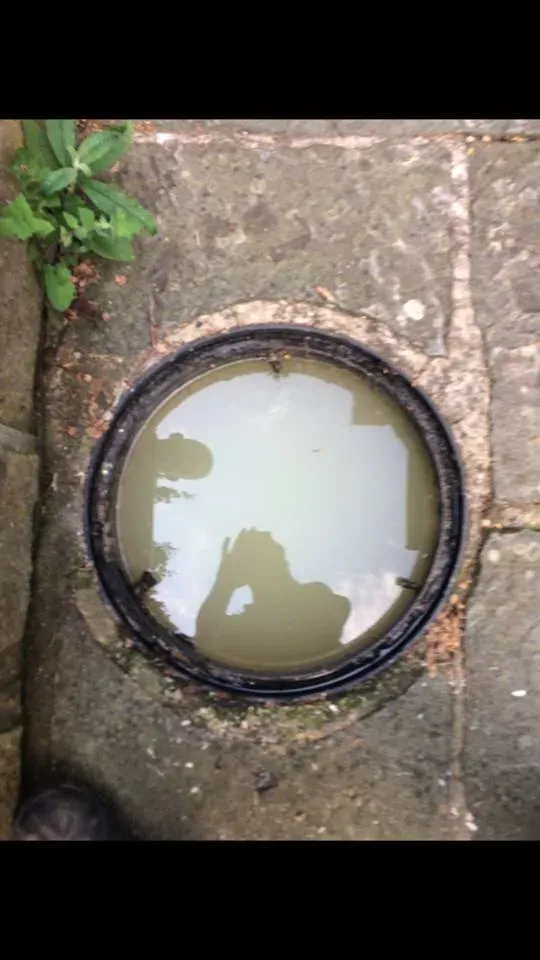
Safety Warning on Lifting Manholes
Never try to prise up a heavy cast-iron or recessed block-paving manhole frame with a screwdriver or garden spade. Old covers rust into their frames and can easily trap fingers or crack your back.
When our engineers attend a blockage, we carry proper heavy-duty lifting keys, test chambers for trapped foul gases, and use high-pressure water jetting (HPWJ) to clear the line from a safe access point before sanitising your patio.
Quick Reference: Who Fixes What?
Use this table to match your specific drainage fault to the right party:
| Where the Problem Is | Who Is Responsible | Why / Exceptions |
|---|---|---|
| Internal toilet, sink, shower, or soil stack | Homeowner / Landlord | Internal plumbing and single-property waste lines are always private. |
| Kitchen outside gully overflowing with fat or suds | Homeowner / Landlord | Gully trap and branch line serve only your kitchen prior to joining the main run. |
| Manhole on your driveway serving only your house | Homeowner / Landlord | Inside your boundary and unshared. Once the pipe crosses under the pavement, United Utilities takes over. |
| Shared manhole in your back garden taking next door's waste | United Utilities | Transferred in 2011. Even though it is on your land, it carries waste from 2+ homes. |
| Blocked street grid or flooded highway kerb | Local Council Highways | Roadside surface water gullies are maintained by Liverpool, Sefton, Wirral, or Knowsley Council. |
| Septic tank, cesspit, or private sewage treatment plant | Property Owner(s) | Off-mains systems are never adopted by the water board, even if shared between rural cottages. |
Common Grey Areas in Merseyside & Sefton Homes
Not every drainage layout fits neatly into a diagram. Across our 20-mile service patch, our engineers regularly trace hidden runs where nobody is quite sure where the pipes go until we drop a camera and sonar sonde down the line:
1. Semi-Detached Properties with Rear Extensions
In 1930s and 1950s semis around Allerton, Childwall, Maghull, and Crosby, the original salt-glazed clay drain runs down the side drive, picking up a branch from next door at the back corner. Often, previous owners built a kitchen extension or conservatory straight over the inspection chamber. The branch from your kitchen gully to that shared run is yours; the shared line itself is United Utilities', unless an unapproved extension damaged the pipe without a formal Build Over Agreement.
2. Coastal Sand Ingress and Pitch-Fibre Runs
Up the Sefton coast in Southport, Birkdale, and Formby, shifting sandy subsoils wash into displaced clay joints on private driveway runs. If the blockage or collapsed pipe sits inside your gatepost before joining the street sewer, you are responsible for clearing the sand silt and lining or repairing the pipe.
3. Private Roads, Unadopted Estates & Commercial Yards
If you live on a private unadopted road, a newly built estate that the developer hasn't handed over yet, or operate a commercial unit on a private industrial park, the main site sewers may still belong to the management company, developer, or commercial landlord.
4. Landlords vs Tenants in Rented Properties
Under Section 11 of the Landlord and Tenant Act, landlords must keep the structure and sanitation pipework in working order. If tree roots crack a drain or an old clay collar drops, the landlord pays. However, if our CCTV drain camera proves the pipe is structurally sound and blocked purely by baby wipes, nappies, or cooking fat poured down the sink, the tenant is usually liable for the clearance cost.
What Happens If We Attend and Find It's a Utility Issue?
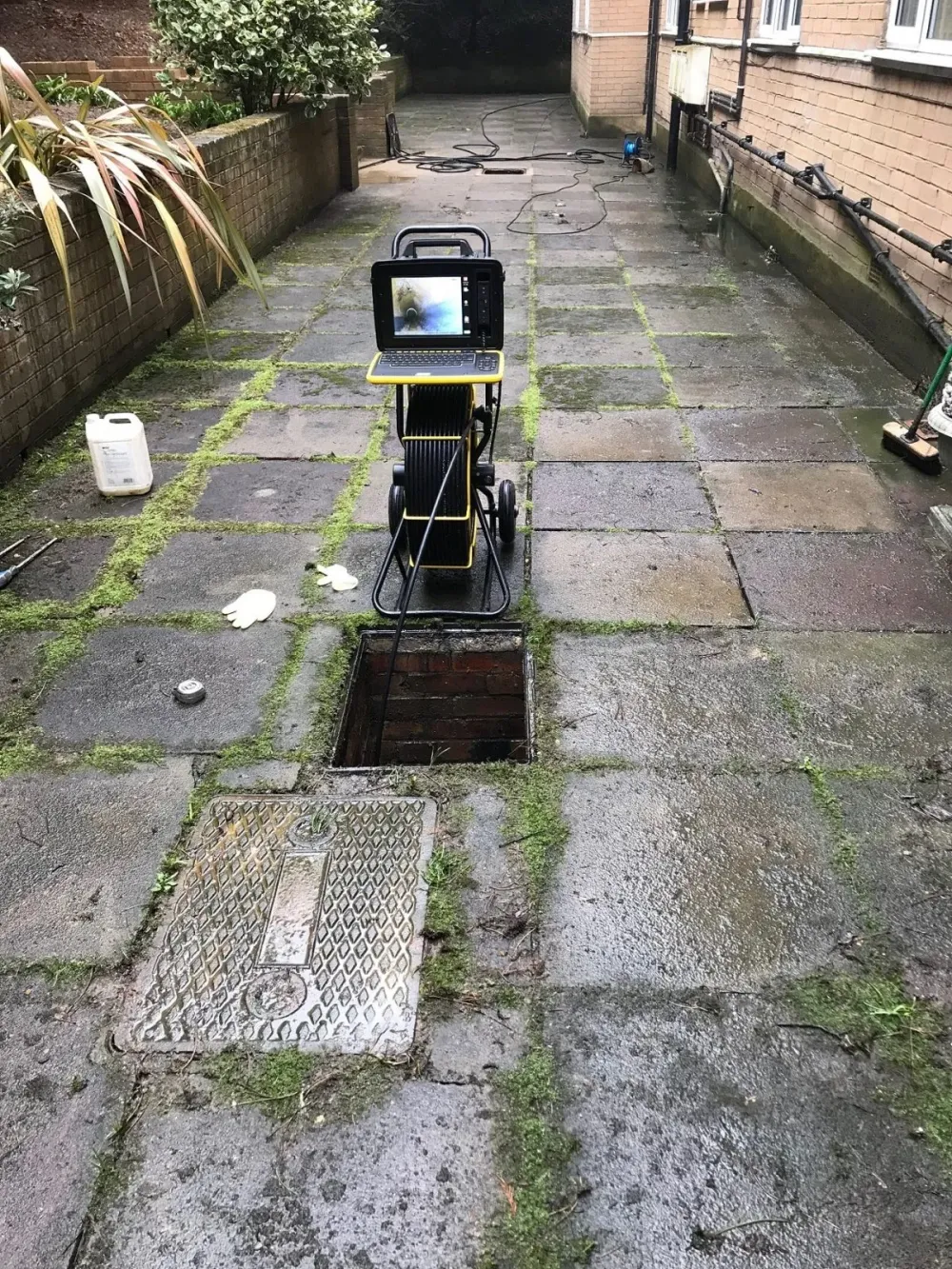
Sometimes it is impossible to tell who owns a blocked pipe until the sewage is jetted down and a self-levelling CCTV camera is pushed into the chamber to see where the connections join.
If you call Liverpool One Drainage out to an emergency blockage, we don't leave you stranded in foul water arguing over boundary lines. We use high-pressure water jetting to clear the immediate blockage so you can use your toilets again, sanitise the overflow area, and then run a quick camera look-see.
If we discover a collapsed pipe or heavy root mass on a shared public sewer or outside your boundary line, we will show you the live HD screen, record the footage, pinpoint the depth and location with a sonar sonde, and give you the exact technical proof you need so United Utilities comes out to excavate and repair their asset at zero cost to you.
Related Services & Guides
Drain Unblocking in Southport
Fast, professional drain unblocking in Southport and Sefton. 24/7 emergency response for blocked toilets, sinks, and sewers with transparent local rates.
How Much Does a Pre-Purchase Drain Survey Cost?
Find out what affects the price of a pre-purchase CCTV drain survey, what a technical report includes, and how buyers use findings to negotiate house prices.
Drain Relining vs Digging Up: Which Fix Is Best?
Find out when a cracked drain can be fixed with a no-dig resin liner and when a collapsed pipe needs open-trench excavation, with honest cost advice.
How Often Do Commercial Drains Need Cleaning?
Find out how often commercial grease traps, stack pipes, and car park gullies need cleaning to avoid kitchen shutdowns and water authority fines.
Do Drain Rat Blockers Actually Stop Rats?
Find out how stainless-steel drain rat blockers stop sewer rats entering your home without blocking toilet flow, why plastic flaps fail, and where to fit one.
Still Unsure If the Blocked Drain Is Yours?
Give our engineers a ring and describe what is happening in your garden or bathroom. We will give you honest, straightforward advice over the phone—and if you need us out today anywhere across Liverpool, Sefton, Southport, or the Wirral, we can be on the road straight away.